
The strategic role of 3D Radars
in modern defense systems

The evolution of airborne threats and the increasing complexity of operational environments are leading armed forces to strengthen their surveillance, identification and early warning capabilities. In this context, 3D radars have become indispensable. Their ability to simultaneously measure distance, azimuth and elevation provides an accurate and actionable picture of the situation.
Beyond their detection performance, 3D radars rely on demanding technical architectures that incorporate critical subsystems whose reliability directly affects operational availability. Among these, hybrid rotary joints play a key role in ensuring the continuous transmission of signals, energy and fluids to rotating antenna structures.
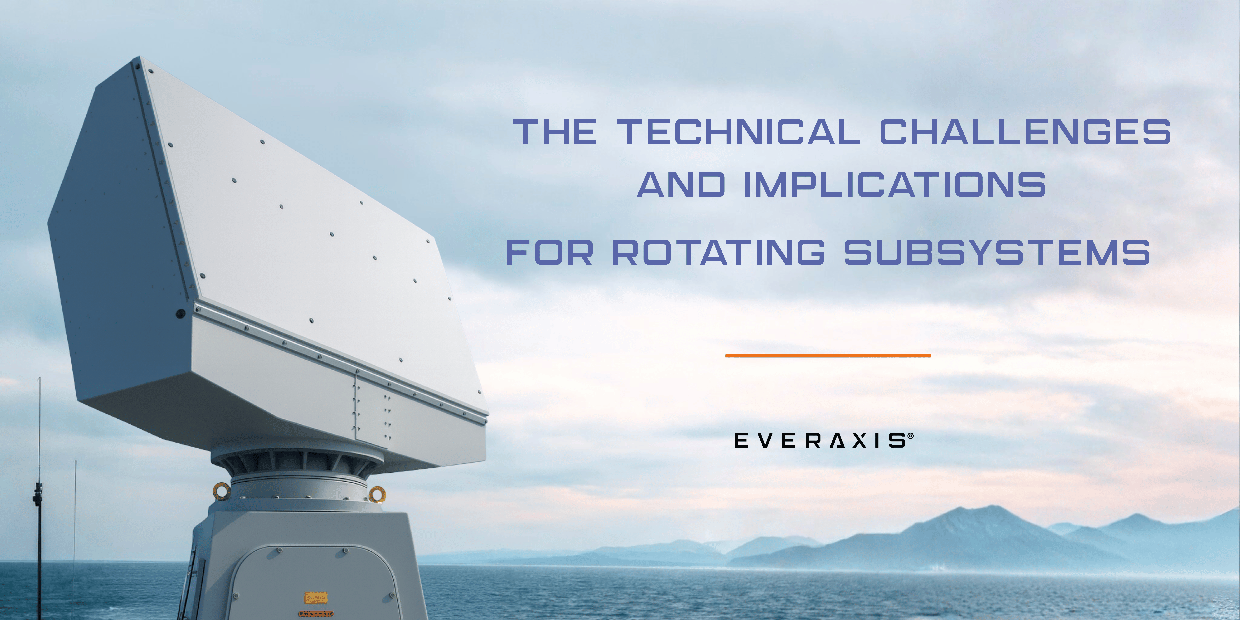
Why 3D Radars have become essential
3D radars differ from traditional 2D radars by providing complete three‑dimensional information. This evolution addresses a growing need for accuracy and responsiveness in air surveillance.
While 2D radars measure only range and azimuth, 3D radars add elevation, enabling more precise target classification, improved discrimination between objects, and more effective multi‑target tracking.
They are now used across a wide range of military applications, including air surveillance, air defense, naval operations, counter‑UAS systems, integrated ISR, mobile platforms, fixed installations, and systems deployed on ships or aircraft. Their versatility explains their increasing adoption in modern defense systems.
Experience across multiple programs of 3D radar systems
Everaxis supports a wide range of 3D radar programs operated by major defence sector integrators. Our rotary solutions are integrated into several categories of operational radars.
- Multi-functional ground-based air surveillance and defence radars
- Lightweight and mobile short-range surveillance and ground-based air defence
- Naval 3D surface radars for simultaneous air and surface surveillance
- Long range tactical radar for early warning air defence
- Primary surveillance radar for air traffic control
- Each radar category presents distinct technical requirements, which Everaxis addresses with custom-designed rotary assemblies
The critical role of rotating subsystems in 3D Radars
3D radar antennas require continuous rotation to provide full coverage. Hybrid rotary joints are therefore critical components within the radar architecture.
Multi‑technology transmission
A hybrid rotary joint may integrate several transmission types within a compact assembly. Depending on system requirements, it may combine:
- RF channels
- Power circuits
- Control and data signals
- Multi‑channel optical fibers
- Fluid channels for cooling
- Integrated encoder for precis
This integration requires a design in which each technology operates without interfering with the others.
Stability of RF performance
Modern 3D radars operate across diverse frequency bands. Rotary joints must maintain low insertion loss, stable isolation, and linearity suitable for radar signals, while supporting high RF power levels.
Durability and reduced maintenance
Because radars are often deployed for extended periods, rotating subsystems must operate for many years without intervention and service. This requires well proven materials in combination with optimized design, to uphold long operational lifetime and reliability.
Key challenges in military 3D radar applications
Across the radar programs supported by Everaxis, several recurring challenges must be addressed:
Reliability and lifetime in mission‑critical systems
Military radar systems must operate for years without interruption, often in remote or high‑risk environments where maintenance is not an option. Everaxis designs are engineered to deliver up to 50 million revolutions before overhaul (MTBO).
Operation in harsh military environments
Extreme temperatures, violent shock loads, and continuous vibration require rotating subsystems capable of delivering stable, failure‑free operation under the most demanding conditions.
SWaP‑optimized architectures and design
Modern radar platforms impose strict Size, Weight and Power constraints. Everaxis integrates multiple rotating functions into compact, lightweight assemblies tailored to next‑generation defense systems.
Signal integrity and power transfer
In environments with strong electromagnetic interference, maintaining clean, high‑speed RF and data links is critical. Everaxis solutions ensure stable, reliable signal and power transmission with minimal disruption during continuous 360° rotation.
Everaxis expertise and differentiators
Everaxis designs and manufactures hybrid rotary joints for demanding applications, including 3D radar systems. This brings together several key areas of expertise:
- Multi‑function rotating assemblies engineered for SWaP‑optimized radar platforms
- Longer lifetime and maintenance‑free operation (>50mil revolutions MTBO)
- Excellent RF performance with low insertion loss and secure isolation
- Ability to integrate highly complex subcomponents into compact, high‑performance designs
- Proven resistance to harsh environmental conditions, shock and vibration
- Compliance with military standards such as MIL‑STD, DEF STAN, and NATO norms
These subsystems are designed for straightforward integration into radar architectures and for long‑term operation without maintenance, contributing directly to overall system availability.
Technological outlook
3D radars have become essential components of modern surveillance and defense systems. Their performance relies on complex architectures in which rotating subsystems play a central role. Through its expertise in multi‑technology integration, precision mechanical design, and expertise of harsh environments, Everaxis contributes to the reliability and performance of these critical systems.
| To learn more about our rotary joint technologies and their integration into advanced radar systems, you may contact our Everaxis Sweden engineering team directly at: 📧 swedenkista@everaxis.com 📞 +46(0) 8 477 6800 |