
Mastering motion and continuity
at the heart of platforms

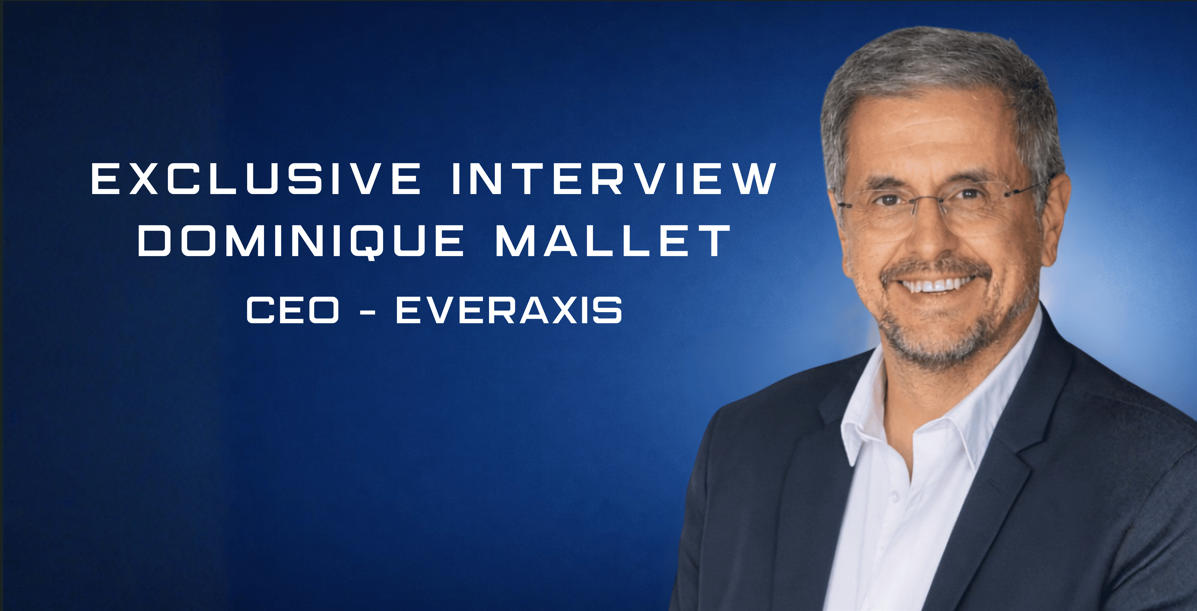
The performance of modern platforms depends directly on the components that ensure motion, stabilization, and uninterrupted power and data transmission. These functions shape sensor accuracy, ISR quality, system availability, and ultimately mission success. Everaxis operates precisely at this level, delivering electromechanical solutions engineered for extreme environments and long‑duration reliability.
In this interview, CEO Dominique Mallet shares his perspective on strategic positioning, cross‑domain challenges, and the future of electromechanical systems in multi‑domain and autonomous operations.
Everaxis at the core of mission‑critical electromechanics
Strategic positioning in platforms architectures
Everaxis positions itself at the “heart of critical functions.” How do you ensure you are seen not as a component supplier but as a strategic partner in platform architecture decisions?
Dominique Mallet: We position ourselves as strategic partners by working upstream through application engineering and co‑design rather than catalog products. Because our systems directly impact mission effectiveness – sensor accuracy, ISR quality, platform availability – we naturally move from component supplier to mission enabler.
By engaging early with primes on SWaP, reliability, and integration trade‑offs, and by mastering motion, power continuity, and mechanical reliability in increasingly software‑defined platforms, we earn our place at the architecture table.
Electromechanical systems are often seen as mature technologies. Where does Everaxis create defensible differentiation versus other suppliers?
Dominique Mallet: Everaxis focuses on what we do best: custom‑engineered components. Differentiation comes from precision under stress, continuity in transmission and motion, and lifetime reliability in harsh environments. Our advantage lies in combining mechanical and electrical engineering, materials science, signal integrity, and environmental qualification into highly customized solutions.
Performance is proven through operational feedback accumulated over thousands of hours.
How is the rise of unmanned and autonomous systems reshaping your product strategy, particularly under SWaP‑C constraints?
Dominique Mallet: Autonomy fundamentally shifts requirements toward miniaturization, energy efficiency, and zero‑maintenance reliability. For UAVs, UGVs, USVs, and UUVs, we redesign systems to deliver lower power consumption without compromising performance, compact integration into constrained payload bays, and extended operational cycles without human intervention. In autonomous missions, failure is not an inconvenience – it is a mission loss.
Mechanical redundancy becomes as critical as software redundancy.
As the battlefield evolves into interconnected, data‑driven networks, what is the future of electromechanical systems?
Dominique Mallet: The misconception is that data challenges are purely electronic or software‑driven. In reality, mechanical interfaces are a bottleneck: slip rings must carry high‑speed data without noise or loss, stabilization systems must preserve image and targeting fidelity, and continuous rotation must maintain perfect alignment under load. We invest in contactless transmission technologies and hybrid architectures to ensure mechanical motion never degrades digital performance. Mechanical precision is now directly linked to data quality and decision superiority.
In contested environments, resilience and availability are becoming strategic priorities. How does Everaxis contribute beyond reliability?
Dominique Mallet: We now engineer for resilience and mission continuity under degraded conditions. This includes systems that maintain minimum operational performance even when partially degraded, designs that reduce single points of failure in rotating interfaces, and materials and architectures that extend mean time between failures in extreme environments. We also support operators with lifecycle durability and maintainability to keep platforms operational longer with fewer interventions.
You emphasize fully custom solutions. How do you balance customization with scalability and cost competitiveness?
Dominique Mallet: We do not see customization and scalability as opposites. Our approach is modular customization: we reuse validated technology building blocks, adapt them through application‑specific engineering, and industrialize at the subsystem level. This ensures optimized solutions without reinventing everything, maintaining both performance and cost control.
In defense applications, performance downgrades from standardization often outweigh cost savings – especially in mission‑critical functions.
Mastering motion, stabilization and continuity across all domains
Domain‑specific constraints and engineering challenges
From outer space to the deepest seas, where does Everaxis create the most mission‑critical impact?
Dominique Mallet: Our impact sits at the convergence of motion, stabilization, and uninterrupted power/data transfer – essential everywhere, but differently critical in each domain.
Space requires precision pointing, antenna rotation, deployment mechanisms, and zero‑maintenance reliability. Air demands stabilization under vibration, de‑icing, and continuous power in rotating systems. Land requires shock‑resistant stabilization for sensors, turrets, and communications. Naval platforms need corrosion‑resistant continuous rotation. Subsea systems rely on sealed, pressure‑resistant mechanisms operating autonomously over long cycles.
In all cases, a failure in motion control or continuity means “mission aborted.
How do requirements differ between manned and unmanned systems, and how does that shape your engineering priorities?
Dominique Mallet: Manned and unmanned platforms operate together but rely on very different priorities. Manned systems focus on safety, redundancy, and long‑term durability, while unmanned systems demand compact, energy‑efficient, fully autonomous subsystems.
Across domains, this translates into very different constraints – from ultra‑light, low‑power UAV systems to shock‑resistant land platforms and long‑endurance UUV mechanisms.
Because unmanned systems tolerate almost no failure, we design them for zero‑intervention reliability.
What are the most technically challenging environments for maintaining precision motion and stabilization?
Dominique Mallet: Each domain stresses a different aspect of physics: Space brings vacuum, radiation, and extreme thermal shifts. Air introduces high‑frequency vibrations and thermal gradients. Land imposes shocks and discontinuous movements. Naval platforms face constant motion requiring dynamic compensation. Subsea environments push sealing and material science to their limits. The hardest challenge is maintaining micron‑level precision under macro‑scale disturbances. The advantage is that physics is universal – experience transfers across platforms.
How does Everaxis address power and data transfer challenges in rotating systems?
Dominique Mallet: Rotating interfaces are one of the most underestimated constraints in platform design. We address them with advanced slip rings (contact and contactless), high‑frequency rotary joints, and architectures designed for perturbed environments. The objective is simple: zero signal loss and zero power interruption during continuous or high‑speed rotation. This is why Everaxis focuses exclusively on engineered components – these requirements demand engineered solutions.
How do you engineer systems that operate reliably from space vacuum to subsea pressure?
Dominique Mallet: We design not for average conditions but for extreme edge cases: temperature extremes, corrosion, sand, dust, shocks, and deep‑sea pressure. This requires advanced materials and coatings, sealing technologies, high‑cycle fatigue resistance, and extensive qualification testing. The challenge is not survival – it is maintaining performance over time.
Our Centers of Expertise develop common technologies, while Business Units preserve program‑specific constraints, ensuring the best technical and compliant solution.
Engineering the next decade of multi‑domain operations
How will multi‑domain operations and autonomous systems reshape Everaxis’s role?
Dominique Mallet: Three shifts are converging:
- Mass deployment of unmanned systems requiring compact, low‑power, industrializable subsystems.
- Persistent multi‑domain ISR networks demanding permanent rotation and high‑reliability stabilization.
- Cross‑domain interoperability requiring standardized yet adaptable motion systems. Our role becomes even more strategic: ensuring every moving, rotating, or stabilized function enabling sensing, communication, and actuation works flawlessly across all domains.
Where do you see the biggest opportunity for Everaxis in the next decade?
Dominique Mallet: The greatest opportunity lies at the intersection of multi‑domain integration, persistent sensing, and autonomy at scale. Space and subsea are especially promising due to extreme environments, limited maintenance access, and high mission criticality. Our mission is to ensure platforms maintain precision, continuity, and reliability—regardless of domain or duration.
Meet the CEO at Eurosatory
Meet Dominique Mallet on June 15 at the Everaxis stand at Eurosatory
He will be available to discuss the critical electromechanical functions that shape platform performance – motion, stabilization, and continuous power and data transmission – and to exchange with partners and technical teams on the evolving requirements of multi‑domain operations.

| Everaxis on Eurosatory Hall 4 – Stand B56 15–19 June 2026 Paris Nord Villepinte Exhibition Centre Access reserved for accredited professionals |