

From target tracking to engagement:
maintaining performance throughout the transmission chain
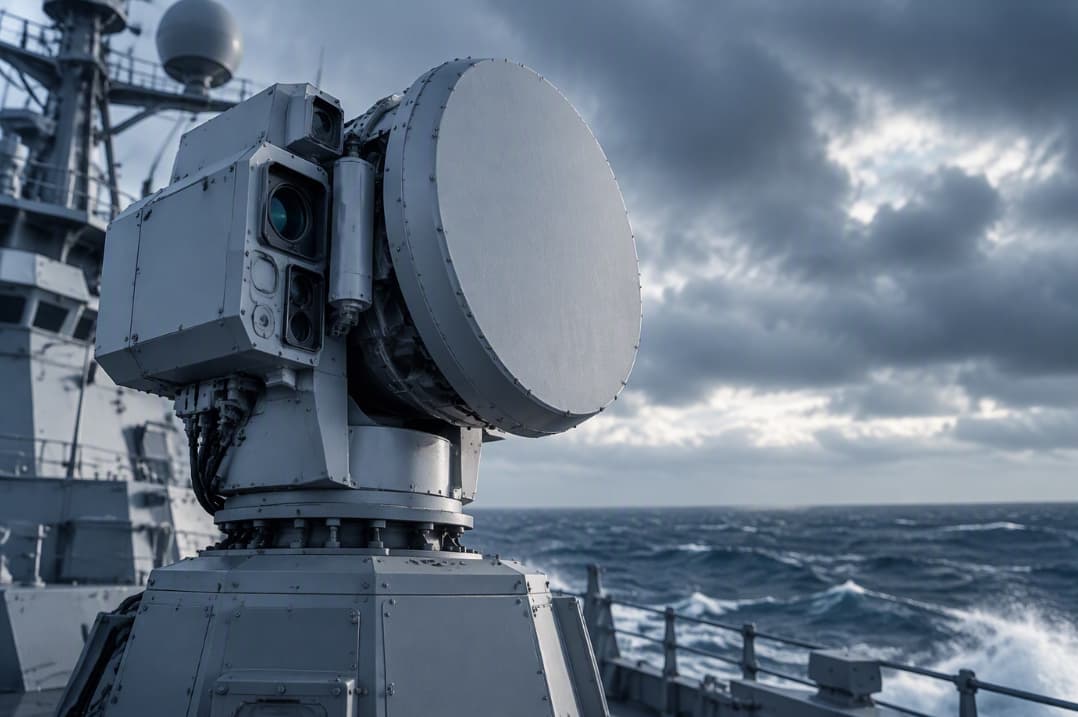
In modern defence operations, Fire Control Radars (FCRs) play a critical role once a potential threat has been detected and designated for engagement. Unlike surveillance radars, which are designed to monitor wide areas and track multiple objects simultaneously, Fire Control Radars focus on a specific target and provide the highly accurate information required to support weapon systems during the engagement sequence.
To maintain target lock, Fire Control Radars continuously process and transmit precise position, range, speed and trajectory data. This becomes especially demanding against fast-moving threats, where minor disturbances can impact tracking performance and mission effectiveness.
Many Fire Control Radar architectures use rotating antennas, requiring uninterrupted transmission of RF signals, power and data between fixed and rotating sections. Transmission must remain stable despite continuous rotation, vibration, shock, temperature variations and harsh maritime conditions.
As a result, radar performance depends not only on the antenna and signal processing capabilities but also on the reliability of the transmission path itself. Rotary interfaces form a critical part of this chain, helping ensure signal integrity, tracking continuity and long-term operational availability throughout the mission.
Why are rotary interfaces a critical subsystem ?
Rotary interfaces provide the transmission path for signals and power between the fixed and rotating sections of the radar.
In Fire Control Radar applications, they must simultaneously meet several requirements:
- Reliable RF signal transmission;
- Electrical power transfer;
- System data transmission;
- Continuous operation during permanent rotation;
- Long-term performance stability;
- Resistance to severe environmental conditions;
- High availability throughout the system lifecycle.
The challenge lies in satisfying all these requirements simultaneously without increasing system complexity or compromising overall radar reliability.
In addition, Fire Control Radar systems often operate where maintenance opportunities are limited and operational readiness is critical. Rotary interfaces must deliver consistent long-term performance while minimizing maintenance and unexpected downtime. This combination of electrical, RF, mechanical and environmental requirements makes the rotary interface a key contributor to overall radar system reliability and mission effectiveness.
Everaxis’ contribution to Fire Control Radar programs
In these mission-critical applications, Everaxis provides its expertise through the design and integration of rotary transmission solutions tailored to the requirements of advanced radar architectures.
A key challenge is transmitting RF signals, power, high-speed data and timing signals through a single rotary interface. Everaxis solutions help address this challenge while reducing system footprint and complexity.
Drawing on decades of defence experience, Everaxis develops rotary solutions that maintain stable RF and electrical performance throughout system life.
Beyond supplying the product itself, Everaxis also supports prime contractors and system integrators during the definition, integration, qualification and verification phases. This collaborative approach allows engineering teams to anticipate potential integration challenges early in the program lifecycle. By working closely with customers from the initial design stages, Everaxis helps optimize interface configurations, accommodate platform-specific constraints and ensure compatibility with evolving radar architectures. Whether supporting naval fire control systems, ground-based air defence platforms or other mission-critical defence applications, Everaxis leverages extensive expertise in RF rotary joints, slip rings and integrated rotary solutions to meet demanding operational requirements.
The collaboration will initially focus on joint development and pilot programs, with a roadmap toward qualification and deployment in mission-critical aerospace, defense and industrial platforms.
Particular attention is given to signal integrity, reliability and long-term maintainability, helping customers achieve both technical and operational objectives.
The resulting benefits include:
- Reliable transmission of mission-critical signals;
- Reduced system-level technical risk;
- High operational availability;
- Extended service life;
- Predictable and controlled maintenance;
- Optimized integration within existing and future radar architectures.
Supporting the next generation of Fire Control Radars
As threats continue to evolve, radar systems are required to deliver ever-higher levels of precision, responsiveness and availability. While the performance of a Fire Control Radar naturally depends on its antenna and processing capabilities, it also relies on the reliability of the entire transmission chain.
In this context, rotary interfaces can no longer be considered simple mechanical components. They directly contribute to the system’s ability to maintain accurate and continuous target tracking under the most demanding operational conditions.
By combining RF expertise, mechanical robustness and integration support, Everaxis helps address the transmission challenges faced by Fire Control Radar programs.
Emerging radar systems must support growing data volumes, advanced sensors and greater connectivity. As these requirements evolve, rotary interfaces must continue to support the simultaneous transmission of RF signals, power, data and synchronization signals without compromising performance. Everaxis continuously develops its technologies to address these evolving needs while supporting the long-term reliability and availability expected in defence applications.
Defining the right rotary interface for your radar system
Every radar architecture presents its own challenges in terms of RF transmission, power transfer, data communication, environmental constraints and service life requirements. Defining the appropriate rotary interface is therefore a critical step in ensuring system performance and availability throughout its operational lifecycle.
Drawing on extensive expertise in defence environments and mission-critical radar applications, Everaxis supports system integrators and prime contractors in designing solutions tailored to the specific requirements of each program.
Need to evaluate the rotary interface requirements of a Fire Control Radar program or discuss a specific system architecture? Contact our experts to explore the most suitable solution for your application.
| To learn more about our rotary joint technologies and their integration into advanced radar systems, you may contact our Everaxis Sweden engineering team directly at: 📧 swedenkista@everaxis.com 📞 +46(0) 8 477 6800 |