
Surveillance Radar

Architecture, engineering constraints and the role of Everaxis rotary interfaces
Surveillance radars impose particularly demanding technical constraints: continuous antenna rotation, transmission of high‑frequency RF signals while in motion, management of ever‑increasing data rates, resistance to corrosion, and the need to maintain mechanical stability essential to beam accuracy.
Every element of the rotary chain directly influences the system’s range, resolution and availability.
For manufacturers, the reliability of rotary interfaces becomes a critical factor, especially when radars must operate 24/7 in demanding maritime, land‑based or airborne environments.
Everaxis solutions are designed precisely to meet these requirements..
Functional framework of a surveillance radar
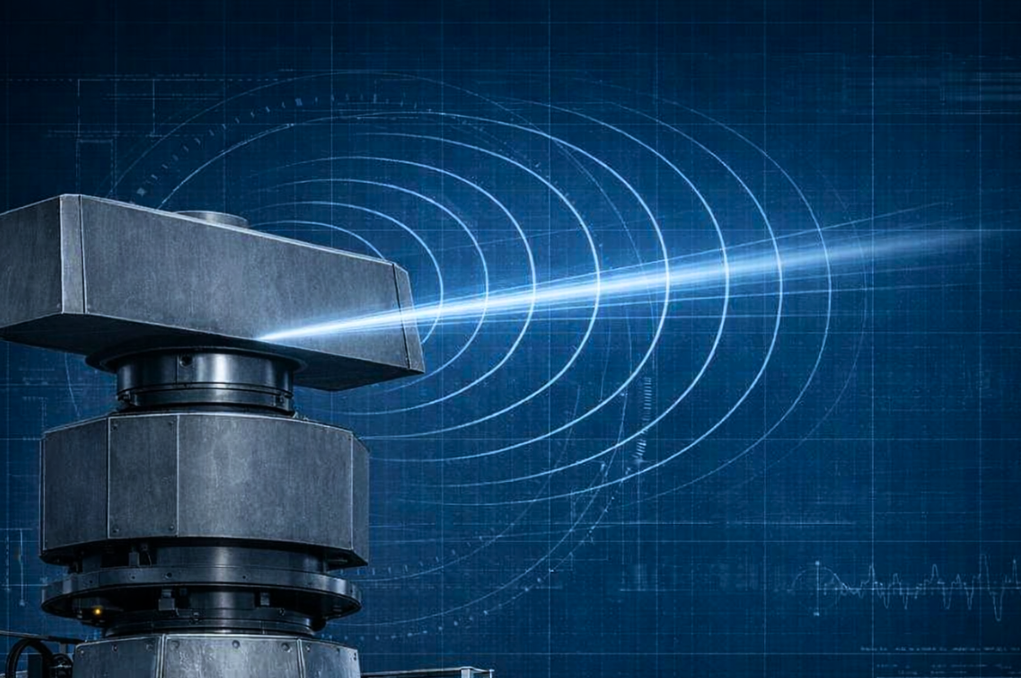
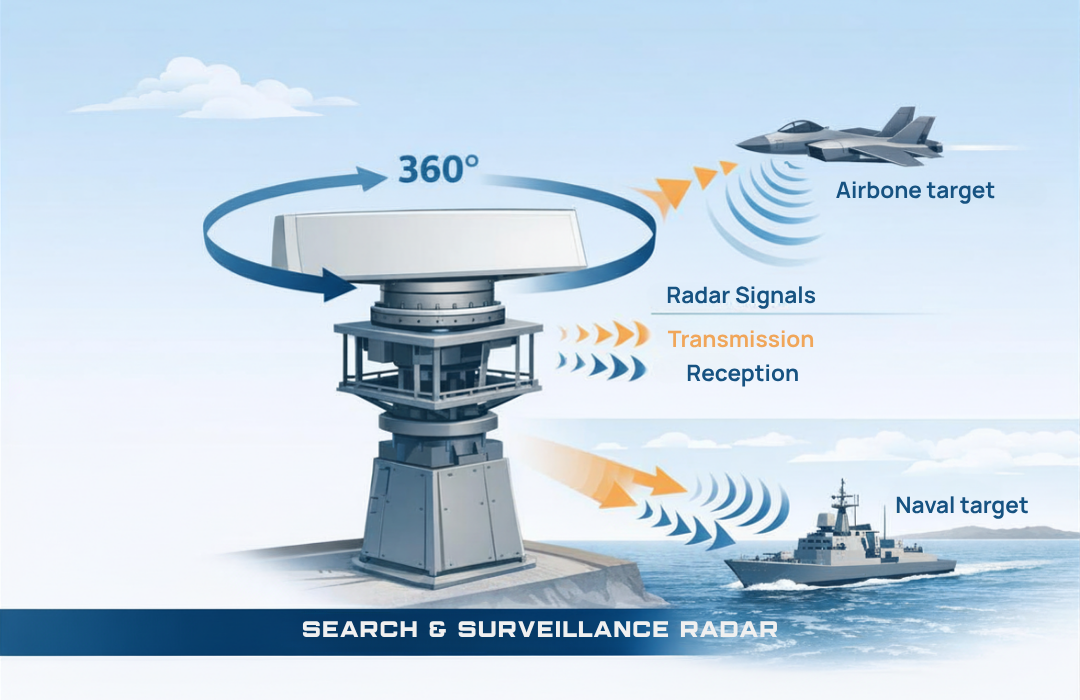
A surveillance radar emits microwave signals, either pulsed or pulse‑Doppler, to detect and track moving objects in the air, at sea or on land.
It provides an up‑to‑date picture of the operational environment by ensuring continuous scanning, typically over 360°, through mechanical rotation or electronic beam steering in the case of AESA antennas.
Its performance depends on range, resolution, rotation speed and the ability to manage multiple targets simultaneously, even in the presence of clutter, adverse weather conditions or jamming attempts.
Architecture and functional requirements
Most surveillance radars rely on a mechanically rotating antenna to cover the full horizon. Rotation speed determines the scene refresh rate, while angular and range resolution depend on beamwidth, transmitted power and signal processing.
AESA systems introduce electronic beam steering but often retain mechanical rotation to ensure complete coverage. Signal stability, low noise and the ability to track multiple targets simultaneously are essential parameters. Radars must maintain performance despite clutter, weather effects or jamming, which places high demands on RF chain quality and the mechanical precision of the rotating assembly.
Mechanical and environmental constraints

Surveillance radars are installed on platforms exposed to significant mechanical and environmental stresses. Vibrations, shocks, salt, humidity, dust or ice impose stringent requirements on rotating components.
Continuous rotation, sometimes 24/7 over several decades, requires interfaces capable of maintaining consistent mechanical precision and stable signal integrity.
Operational availability is a key criterion. Systems must offer high MTBF and extended maintenance intervals, which implies increased resistance to wear, corrosion and contamination. Mechanical stability and sealing quality directly influence overall radar performance.
Rotary transmission: RF, data and power
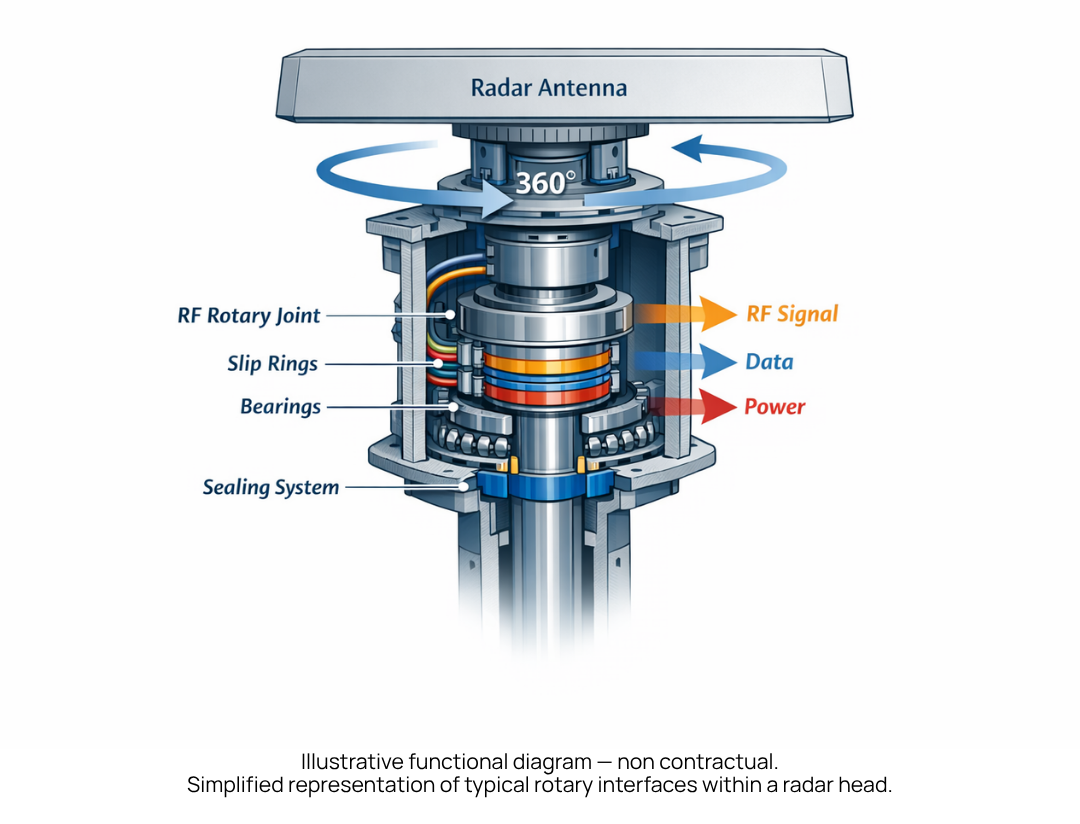
The antenna head must simultaneously transmit high‑frequency RF signals, high‑speed data and electrical power. This rotating transmission relies on several critical subsystems: RF rotary joints, slip ring modules, bearings and sealing systems.
The identified technical challenges include:
- maintaining RF signal integrity during rotation,
- handling ever‑increasing data rates,
- limiting electrical and mechanical noise,
- reducing wear on contact surfaces,
- ensuring effective protection against corrosion and environmental ingress,
- guaranteeing stable rotation to preserve radar beam accuracy.
These constraints directly affect detection range, resolution and target‑tracking reliability.
Common failures and manufacturer expectations
Operators frequently encounter mechanical wear, corrosion in maritime environments and progressive degradation of RF or data performance.
Sealing failures can lead to internal contamination, while older architectures sometimes struggle to meet current bandwidth requirements. Manufacturers seek solutions that increase service life, reduce maintenance needs, improve RF performance and offer more compact interfaces integrating RF, power and data within a single rotating assembly.
Trends and future developments
Expected developments in the coming years include increased digitalisation, higher RF and data throughput, more compact radar architectures and growing use of artificial intelligence.
Materials and manufacturing processes will also evolve to improve durability and reduce weight. These transformations reinforce the demands placed on rotary interfaces, which will need to offer wider RF bandwidth, greater integration of RF, power and data, enhanced durability and even higher mechanical stability.
Everaxis AB expertise: high‑precision RF and mechanical design
Everaxis AB in Sweden develops and produces RF rotary joints, often combined with integrated slip rings. Local expertise covers RF design, mechanical engineering, prototyping, precision machining, assembly and environmental and performance testing.
Everaxis solutions stand out for their robustness, long service life and ability to maintain high signal integrity in maritime, land‑based or airborne environments. They are designed to meet the requirements of continuous rotation, mechanical stability and RF performance specific to surveillance radars, while anticipating future industry needs.
Surveillance radars require rotary interfaces capable of operating without interruption, with consistent precision and reliability.
Everaxis supports manufacturers and integrators in designing solutions tailored to their mechanical, environmental and RF constraints.
| To discuss your project or explore our custom development capabilities, we invite you to contact our team ! 📧 swedenkista@everaxis.com 📞 +46(0) 8 477 6800 |